

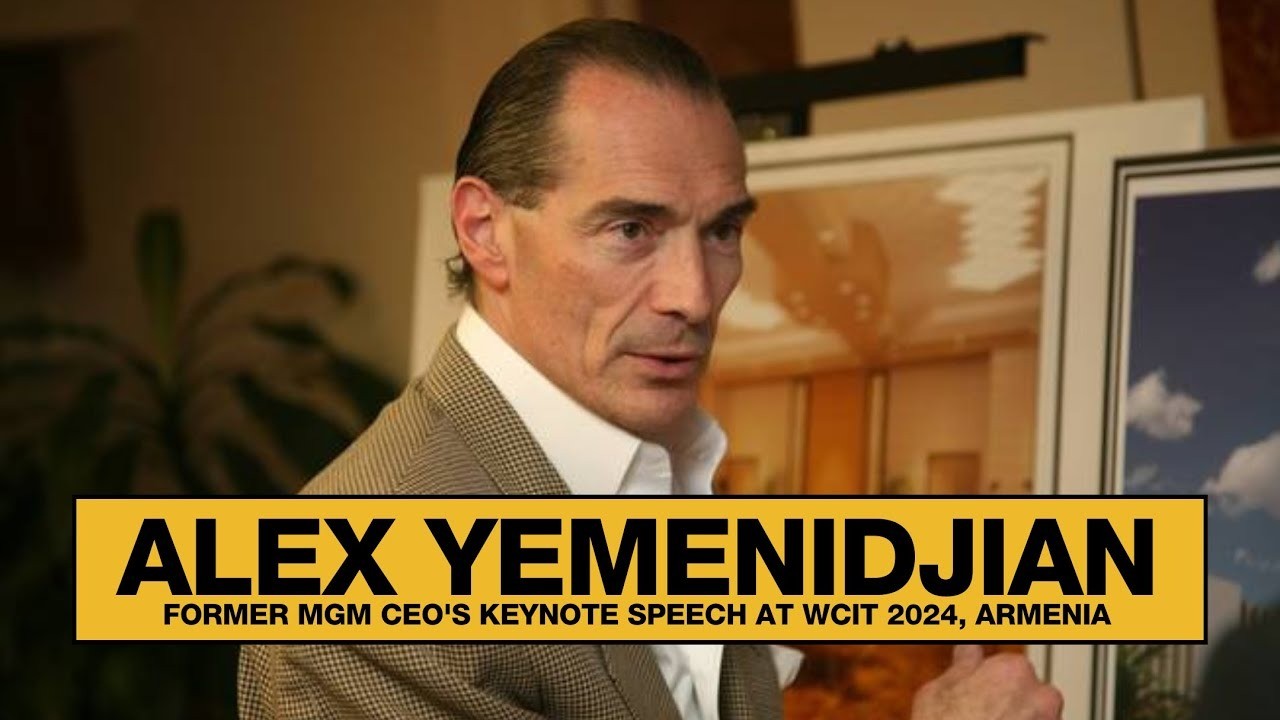
At the recent World Congress on Information Technology (WCIT) 2024, former MGM CEO Alex Yemenidjian delivered a keynote speech on leadership. He emphasized the role of the next generation in driving innovation and entrepreneurship in Armenia. He also spoke about venture capital in tech, which, in his opinion, is the match that needs to fire and ignite Armenia’s transformation into an idea factory.
In his speech, he focused on the importance of failure, sharing valuable lessons he had learned from both his personal experiences and business life, which he learned by working with Kirk Kerkorian. So, Mr. Yemenidjian emphasized that strong character is the foundation of great leadership, explaining that character is defined by who you are and what you do when no one is watching.
He recounted a personal experience where he faced a tough choice about whom to sell to and how, ultimately, Kirk Kerkorian advised him to keep his word and the promise he had made. He stressed that keeping one’s word and one’s reputation are values that should never be compromised, no matter the price. This same principle, he explained, extends to philanthropy. Kerkorian believed that true charity is giving without expecting anything in return, not even recognition, because it will no longer be a charity. Another thing that he learned about charity is that it should be big enough to make a difference.
He also shared valuable business lessons from Kirk Kerkorian, focusing on the difference between system 1 and system 2 thinking, as described in Daniel Kahneman’s book “Thinking, Fast and Slow.” He explained that system 1 is fast, instinctive, emotional, and unconscious, whereas system 2 is slow, deliberate, highly calculated, and logical, guiding more thoughtful responses when a problem happens. His advice, which Mr. Kerkorian had learned, was to focus on not trying to do everything—rather, to concentrate on doing a few things exceptionally well and to avoid rushing decisions. “Warning to the new generation, multitasking is totally overrated, laser-like focus is a huge competitive advantage, especially if you want to use system 2 thinking, stated Mr Yemenidjian.
He also talked about the importance of being confident and embracing a “go big or go home” mentality. While it is taught in school that diversification is essential for investments, he noticed that Mr. Kerkorian had his entire net worth tied up in just two companies. Curious about this contradiction, he asked Kerkorian about it. Without missing a beat, Kerkorian replied, “Alex, diversification is for people who aren’t sure about what they’re doing.” This insight highlighted the value of conviction and focus in achieving success.
In his speech, he emphasized that common sense holds far more value than a degree from an even a prominent university. He reflected on his journey to understanding this truth, realizing that while many people know the what, where, when, and how, few grasp the why behind their actions. He pointed out that the world is filled with individuals who may know everything yet understand nothing. So, the most crucial question in business is “why.” Knowing how to do something ensures job security, but understanding why it matters for leadership. He recounted that phrases like “I don’t know” or “I’m not sure” were never acceptable in the presence of Kirk Kerkorian.
This expectation pushed him to learn the true meaning of excellence, which involved anticipating questions and having the correct answers ready. He admitted to falling short many times and frequently stepping out of his comfort zone, where true progress happens. Staying within one’s comfort zone often leads to stagnation.
According to Mr Yemenidjian, excellence means providing the best—not just being better than most. He encouraged the audience to strive for excellence, stating that “good enough is just not good enough.” To achieve excellence, one must care more than others think is wise, take risks beyond what others deem safe, and dream bigger than what others consider practical. He asserted that attitude and motivation are far more critical than IQ in this pursuit.
He concluded his speech with a powerful message that left the audience deep in thought: “Your attitude and the choices you make today will construct the house in which you will live tomorrow, so build it wisely.”